

How to Use a Shoe Stretcher: The Science of Expanding Your Footwear
There is a profound, almost primal psychological weight to the realization that your newly acquired footwear—a masterpiece of handcrafted calfskin—is a fraction of an inch too restrictive. In the high-stakes world of corporate boardrooms or grand social galas, even the slightest pinch can derail a person's presence. For decades, the conventional "wisdom" was to simply endure the pain, a concept known as "breaking them in with blood." However, modern podiatry and material science have rendered this masochistic approach obsolete. Statistics from the American Podiatric Medical Association (APMA) reveal a staggering reality: over 75% of Americans suffer from foot ailments, many of which are directly linked to ill-fitting shoes. Furthermore, a landmark study in the Journal of the American Podiatric Medical Association indicates that chronic constriction of the forefoot is a primary catalyst for the development of hallux valgus (bunions) and interdigital neuromas.
To address this, we must look beyond mere aesthetics and delve into the biomechanics of footwear. This article serves as a comprehensive, scientifically-grounded manual on how to use a shoe expander. We are not just making a shoe larger; we are performing a controlled anatomical adjustment that respects the integrity of the leather while optimizing the comfort of the wearer.
The Molecular Dynamics of Leather Expansion
Before one picks up a professional shoe stretcher, it is imperative to understand the substrate. Leather is not a monolithic block of material; it is a complex, biological matrix of collagen fibers that have been stabilized through the tanning process. During tanning, cross-links are formed between these collagen strands to prevent decay. When a shoe feels "tight," it means these fibers are in a state of high tension and have not yet been acclimated to the dynamic volume of your foot.
The science of expanding footwear lies in the temporary disruption of these hydrogen bonds. By introducing a specific amount of moisture and controlled mechanical stress, we can induce "creep"—a term in materials science where a solid material moves slowly or deforms permanently under the influence of persistent mechanical stresses. When we apply a shoe stretcher, we are effectively re-orienting the collagen weave into a new, expanded equilibrium. This is why the process must be slow; a sudden force will snap the fibers, whereas a gradual tension allows them to slide past one another and reset.
Anatomical Precision: The Hardware of Comfort
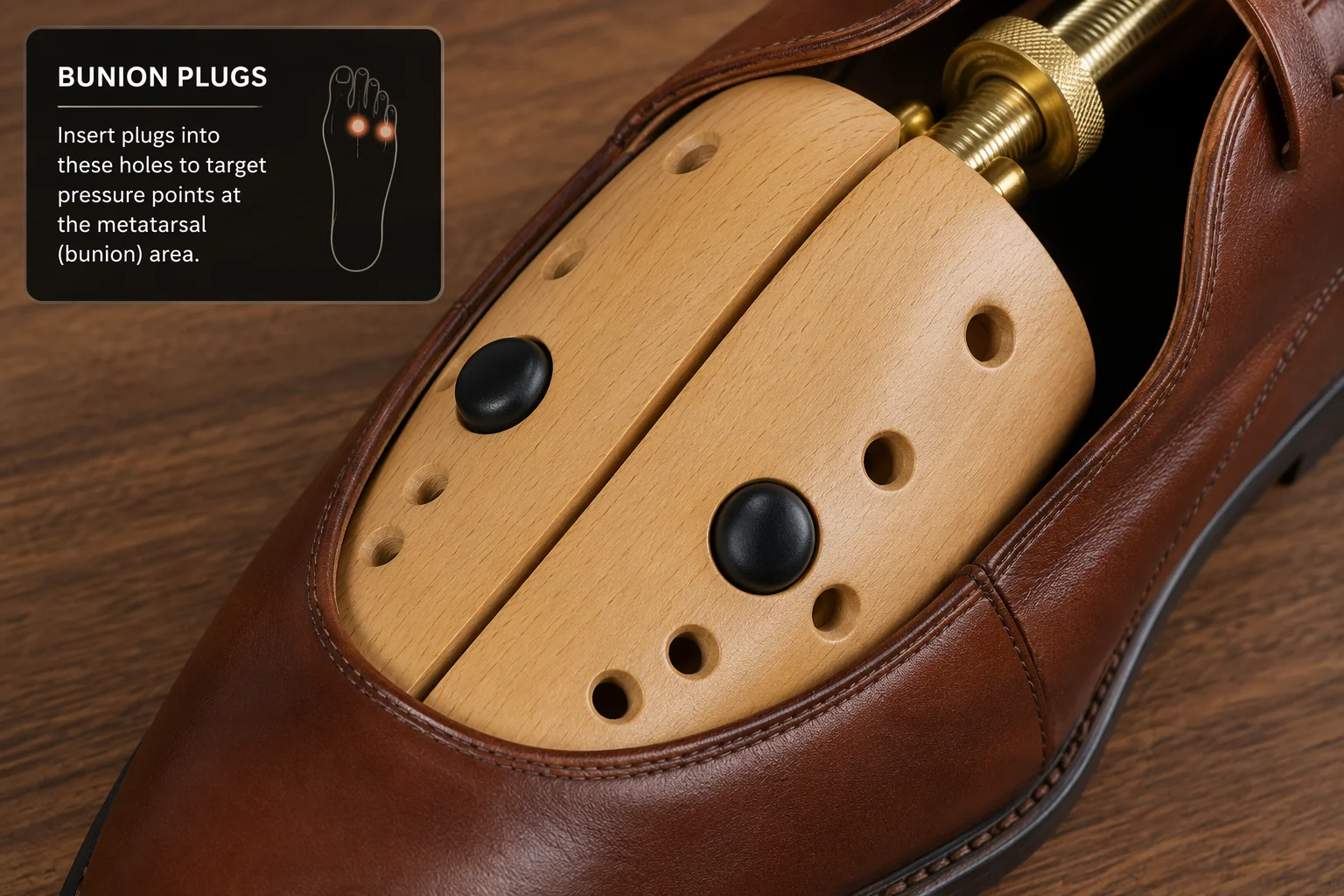
Not all stretchers shoes are created equal. To achieve a professional result, one must move beyond the plastic "trees" found in discount stores and invest in orthopedic-grade hardware.
The Two-Way Mechanical Advantage
A professional shoe stretcher operates on two distinct axes. The length adjustment, typically controlled by a heavy-duty screw connected to a contoured heel block, targets the longitudinal axis. This is vital for those whose toes are pressing against the front of the toe box. The width adjustment, operated by a central handle that cleaves the wooden toe block, targets the lateral expansion. A high-quality tool allows these two forces to be modulated independently, preventing the "unbalanced stretch" that can warp a shoe's silhouette.
Bunion Plugs and Localized Orthopedic Relief
The most distinctive feature of professional stretchers shoes is the inclusion of "bunion plugs"—small, modular plastic nodes. These are not decorative. They are designed to be inserted into pre-drilled ports on the toe block to create localized "bulges." For individuals suffering from bunions, hammertoes, or specific bony prominences, these plugs allow for surgical-like precision in creating relief exactly where the foot requires it, without unnecessarily over-expanding the rest of the shoe.
The Multi-Phase Protocol: A Step-by-Step Science

Achieving a bespoke fit is a methodical process that requires patience and the correct environment. Follow this expanded protocol to ensure your footwear remains as beautiful as it is comfortable.
Phase 1: Material Preparation and Fiber Lubrication
Never attempt to stretch dry leather. Dry fibers are brittle; they do not expand, they fracture. Start by applying a specialized stretching spray or a deep-penetrating leather conditioner. The goal is to reach the "glass transition" state of the collagen fibers, where they become pliable. Focus the application on the interior of the shoe to ensure the solution reaches the un-finished side of the hide, which is more porous and receptive to hydration.
Phase 2: Strategic Insertion and Alignment
Carefully guide the stretcher into the footwear. If your shoes have delicate linings (such as silk or thin sheepskin), consider placing a thin cloth between the stretcher and the lining to prevent pressure marks. Ensure the toe block is seated firmly into the toe box, and the heel block is resting squarely against the heel counter.
Phase 3: The Incremental Tensioning Process
This is the phase where most mistakes occur. Rotate the length knob until the shoe is taut. Then, begin expanding the width. Turn the handle until you feel a firm resistance, then stop. Professionals use the "quarter-turn rule": every 6 to 8 hours, return to the shoe and provide a 90-degree turn of the handle. This slow, incremental progression mimics the natural breaking-in process but without the physical trauma to the wearer’s feet.
Phase 4: The Stabilization Period
Leather has "elastic memory," a tendency to return to its original shape. To overcome this, the stretcher must remain in place for a minimum of 24 to 48 hours. During this period, the moisture evaporates, and the collagen fibers "set" in their new, elongated configuration. For heavy leathers like bridle or cordovan, a 72-hour stabilization period may be necessary.
Material Specifics: Navigating the Texture Map
The effectiveness of a shoe expander varies wildly depending on the hide's origin and tanning method.
- Calfskin and Box Calf: These are the gold standard for stretching. Their fine grain and high collagen density allow for significant expansion without losing luster.
- Suede and Nubuck: These materials are highly porous and stretch very easily—often too easily. One must be extremely cautious not to over-expand, as suede can quickly lose its structural "snap" and become baggy.
- Exotic Skins (Alligator, Lizard): These are the most dangerous to stretch. The scales are held together by a thin membrane that is prone to tearing. Stretching should only be done by a master cobbler or with extreme caution and high levels of specialized lubrication.
- Synthetic/Patent Leather: Patent leather is essentially leather coated in plastic. The plastic does not have a fiber matrix; it will often crack or delaminate if stretched. Traditional stretchers shoes have limited effect on synthetics.
Expert Insights: The 70MAX Footwear Panel

"We don't just stretch leather; we negotiate with it," says Dr. Alistair Thorne, a footwear engineer and consultant for the 70MAX Expert board. "The objective is to achieve what we call 'Permanent Set.' In our labs, we use calipers to measure expansion down to the tenth of a millimeter. For the average user, the takeaway is simple: if you force the leather, the leather will fail. If you lead the leather with moisture and time, it will follow."
Dr. Thorne highlights a critical safety point: the "Welt Integrity." The welt is the critical junction where the upper meets the sole. Excessive use of a professional shoe stretcher can stress the welt stitching to the point of failure. "A shoe that is wide enough but has a compromised sole is a liability, not an asset," he adds.
Orthopedic Benefits: Beyond Simple Comfort
Using a shoe expander is often a medical necessity rather than a luxury. For individuals with chronic foot conditions, a few millimeters of extra space can mean the difference between mobility and a sedentary lifestyle.
- Neuroma Relief: By expanding the forefoot, you reduce the pressure on the intermetatarsal nerves, effectively "decompressing" the area.
- Bunion Management: Targeted stretching prevents the shoe from forcing the big toe inward, which can slow the progression of bunion deformities.
- Hammertoe Clearance: Increasing the vertical height of the toe box (using specialized high-toe stretchers) prevents the constant friction that causes painful calluses on curled toes.
User Experience: Real-World Calibration
"I am a field architect, and I spend 10 hours a day on my feet in leather boots. I used to buy shoes a half-size larger to avoid pain, but that led to stability issues. Now, I buy my true size and use a professional cedar stretcher for 48 hours before the first wear. It has completely eliminated my plantar fasciitis flare-ups." — Gregory S., Seattle.
The Product Arsenal: Selecting Your Tools
Investing in the right shoe stretcher is a one-time purchase that protects a lifetime of footwear.
| Tool Category | Best Material | Key Feature | Recommendation |
|---|---|---|---|
| Pillar Stretcher | Polished Cedar | Moisture/Odor absorption | FootFitter Premium Professional |
| High-Heel Stretcher | Hardwood/Metal | 45-degree angle shank | HoundsBay High Heel Stretcher |
| Boot Stretcher | Cast Iron | Extra-long handle | Cobbler’s Choice Heavy Duty |
Professional Tip: Always choose cedar over pine or plastic. Cedar wood contains natural oils that protect the leather's interior from fungal growth while it is being stretched—a critical factor during the 48-hour moisture phase.
Frequently Asked Questions (FAQ)
Can a shoe stretcher make a shoe longer?
Yes, a professional shoe stretcher with a length adjustment knob can increase length by approximately 1/4 to 1/2 of a size. However, it cannot fundamentally change the size of the sole.
Is it safe to stretch my shoes multiple times?
You should aim to get the fit right in one session. Repeatedly stretching and shrinking leather can fatigue the collagen fibers, eventually leading to a loss of shape and "sagginess."
Will the stretching spray stain my shoes?
Most high-quality sprays are alcohol-based and evaporate cleanly. However, always perform a patch test on an inconspicuous area (like the inner tongue) to ensure the dyes are color-fast.
Can I stretch my shoes by putting them in the freezer with bags of water?
This is a dangerous internet "hack." Water expands in all directions when it freezes, which provides no control over the shape. It can easily burst the seams or damage the internal structure of the shoe. Stick to a mechanical shoe expander.
Why do my shoes feel tight again after a week?
This is "snap-back." It usually happens if the shoes weren't left on the stretcher long enough or if they weren't sufficiently hydrated. Repeat the process and ensure a full 48-hour stabilization period.
Can I stretch sneakers?
Sneakers made of canvas or real leather can be stretched. However, those made of heavy rubber or thick synthetics will likely return to their original shape immediately.
What should I do if the leather starts to look pale?
This is a sign of stress. Stop stretching immediately and apply a rich leather cream to re-nourish the area. The paleness is caused by fibers being pulled too thin.
Conclusion: Mastering the Art of the Perfect Fit
Expanding your footwear is an exercise in craftsmanship and restraint. By treating your shoes with the respect they deserve and using a professional shoe stretcher as a tool of precision rather than force, you can transform even the most challenging pair of oxfords or boots into a bespoke experience. Remember, the ultimate goal of a shoe expander is to serve the foot, ensuring that every step you take is a testament to both style and health.